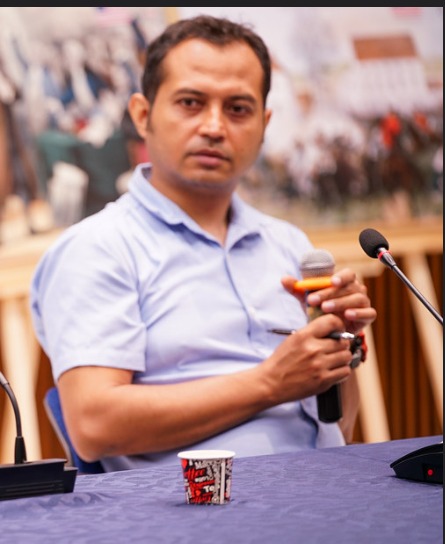
Joydeep Bhowmik

Conclave Researcher

Joydeep Bhowmik

Assistant Professor · Aerospace engineering and applied mechanics · IIEST Shibpur

Address IIEST, Shibpur, P.O. - Botanic Garden, West Bengal, India Howrah - 711103 Email joydeep@aero.iiests.ac.in

About my research

My research asks a practical question: how can we design flying machines that are more capable, adaptable, and reliable outside the ideal conditions assumed in textbooks? I work at the intersection of aerodynamics, flight mechanics, mechatronics, and fabrication, with particular interest in small unmanned aerial vehicles, rotorcraft, and flapping-wing aircraft inspired by birds and insects. A central challenge is that small aerial vehicles operate in a world dominated by gusts, turbulence, limited onboard power, uncertain sensing, and tight constraints on size and weight. I study how the shape, motion, and control of a vehicle interact with the surrounding air, and how these interactions determine whether it remains stable, manoeuvrable, and energy-efficient. This includes aerodynamic modelling, stability and control, and fluid–structure interaction, especially where wings or other components deform substantially during flight. Flapping-wing vehicles are a useful example. Unlike a conventional fixed-wing aircraft, a flapping wing both generates lift and propulsion through a continuously changing, flexible motion. Understanding such systems requires combining mechanics, unsteady aerodynamics, actuation, sensing, and control. The aim is not simply to imitate nature, but to identify design principles that can make compact aerial robots useful in confined, cluttered, or difficult-to-access environments. My work also emphasizes turning ideas into working systems. I use system integration, reverse engineering, manufacturing, prototyping, and flight testing to connect analytical models with real vehicles. This matters because an elegant aerodynamic concept has limited value unless it can be built, controlled, repaired, and operated reliably with realistic materials, electronics, and energy sources. The broader motivation is to expand what aerial platforms can do: inspection of infrastructure, environmental observation, search and rescue, scientific measurement, and other tasks where conventional aircraft may be too large, fragile, expensive, or inflexible. By treating flight as a coupled problem of air, structures, mechanisms, sensors, and control, I aim to develop aerial systems that are not only novel, but genuinely deployable
Aerodynamics and flight mechanics UAVs and aerial robotics Flapping-wing aircraft Mechatronics and system integration Fluid–structure interaction Aerospace product development
Current research challenge

How to make small aircraft more stable and controllable. How to improve flight efficiency under limited power and weight. How wings and structures deform during flight and affect performance. How to design UAVs, ornithopters, and rotorcraft that work in real conditions. How to combine aerodynamics, control, sensors, and mechanics into one reliable system. How to turn new flight ideas into practical, buildable aerospace products.

Unmanned Aerial Aquatic Vehicle (UAAV)

This webinar showed how a bio-inspired UAAV can seamlessly transition between flight and underwater operation using a rigid foldable wing design.

Bio-inspired flight systems. Work with experts in biology, robotics, or control to improve flapping-wing UAVs and ornithopters. Fluid–structure interaction. Partner with computational mechanics or materials researchers to study flexible wings and deforming aerospace structures. Stability and control of small aircraft. Collaborate with control engineers to make UAVs and rotorcraft more robust in real-world conditions. Aerial robots and novel configurations. Explore unconventional vehicle designs with robotics, mechatronics, and prototyping teams. Experimental aerodynamics. Work with wind-tunnel, measurement, and visualization specialists to validate models and designs. Manufacturing and product development. Collaborate with design and fabrication experts to turn research ideas into practical flying systems.